← Field Notes / Benchmark & Architecture
Does ChatGPT Hallucinate Stock Data? We Tested the Same NVIDIA Prompt in ChatGPT vs. Willow
The Research Request:
“Show NVIDIA's latest annual revenue, gross margin, and data center trajectory with visual key metrics.”
When financial researchers ask whether ChatGPT hallucinates stock data, the issue is rarely model intelligence; it is system architecture. General-purpose assistants answer from memory or run slow sandbox scripts, while specialized AI stock research tools pull live SEC filing receipts. We ran an identical benchmark test on NVIDIA (NVDA) to measure latency, visual interfaces, data freshness, and grounding.
Head-to-Head Comparison Matrix
| Dimension | ChatGPT | Willow |
|---|---|---|
| Response Latency | 23.0 seconds (code execution sandbox) | 1.4 seconds (16x faster) |
| Visual Output | Static Matplotlib PNG + text bar chart | Interactive cards built into the app |
| Data Recency | FY2026 annual (ended Jan 25, 2026) | Q2 FY2027 quarterly (ended July 26, 2026: $89.0B Data Center) |
| Attribution Lineage | Loose web search citation pills | Deterministic SEC receipt citations ([1], [4], [6]) |
| Institutional Alpha | High-level summary of historical totals | 4.25 GW Portsmouth site deal, $105B OpenAI lease guaranty cap |
| Failure Modes | High latency, disconnected static artifacts | Context bleeding across intermediate tool retries |
The Live Anxiety: Does ChatGPT Hallucinate Stock Data?
Independent financial audits in 2026 found inaccurate or hallucinated assertions in up to 41% of finance-related general AI responses. In equity research, even a small factual deviation, such as conflating fiscal years or citing an outdated operating margin, destroys research credibility.
The consensus among serious individual investors and independent wealth managers is straightforward: never make an investment decision on a number an AI pulled from memory. A viable research workflow requires an engine that anchors every number to a public regulatory filing.
To examine how general-purpose language models compare against domain-specialized agents, we submitted an identical prompt to both ChatGPT (with Python Code Interpreter) and Willow (the equity research agent powering brief.finance): 'Show NVIDIA\'s latest annual revenue, gross margin, and data center trajectory with visual key metrics.'
Speed and Interface: 23-Second Matplotlib Image vs. 1.4-Second Generative UI
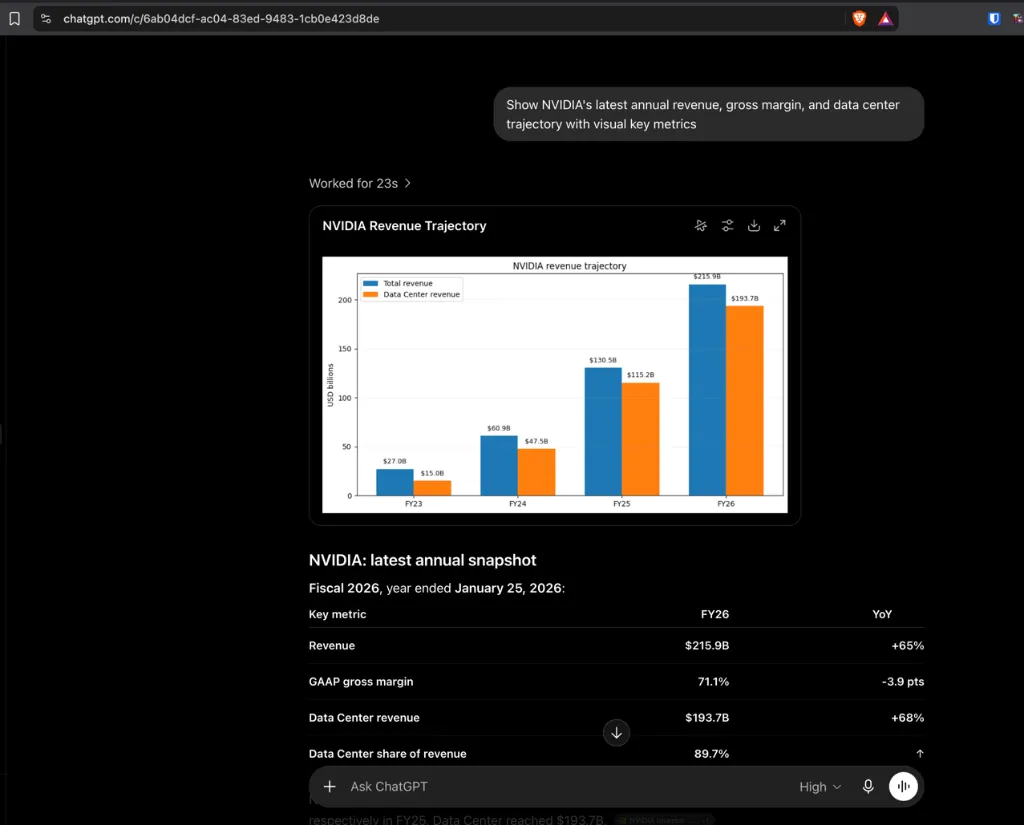
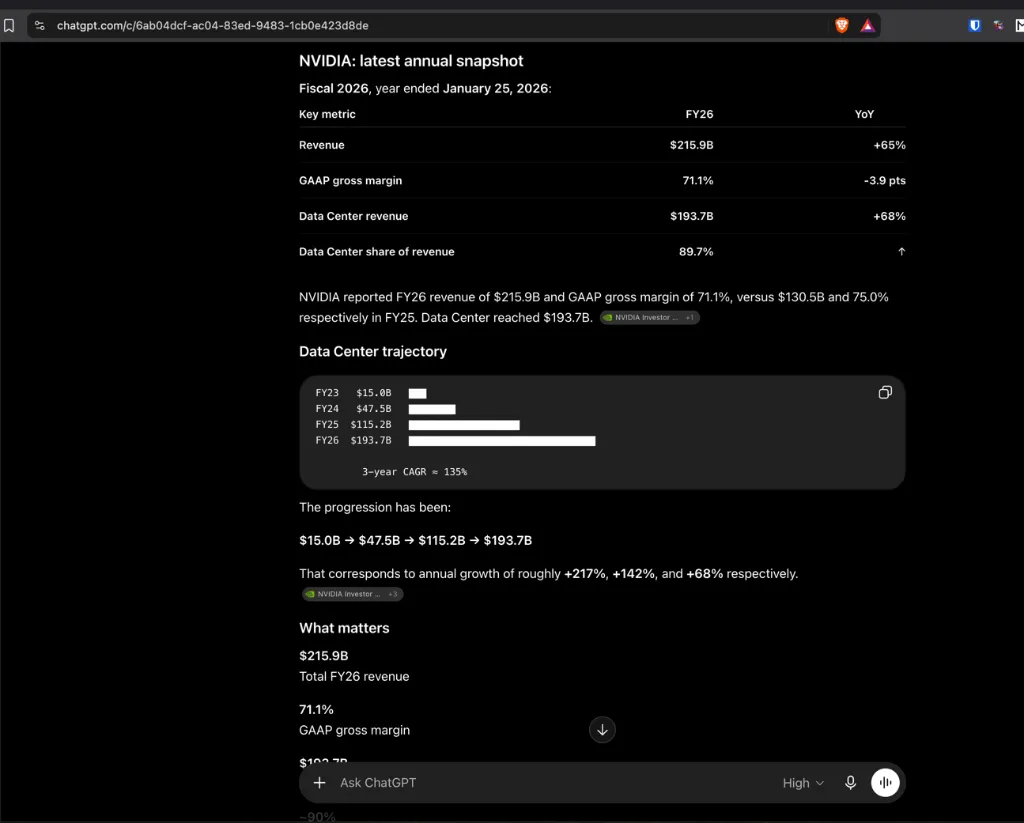
ChatGPT spent 23 seconds processing the request. Because general-purpose assistants lack native frontend UI components for financial data, ChatGPT defaulted to its standard code execution loop: boot an isolated container, generate a Python script using matplotlib, render a dual-bar chart comparing Total Revenue against Data Center Revenue from FY23 to FY26, and export a static .png image into the chat.
While the generated plot answered the concept of 'trajectory', waiting nearly half a minute breaks active research momentum. Furthermore, a static image cannot be inspected, filtered, or copied into financial models.
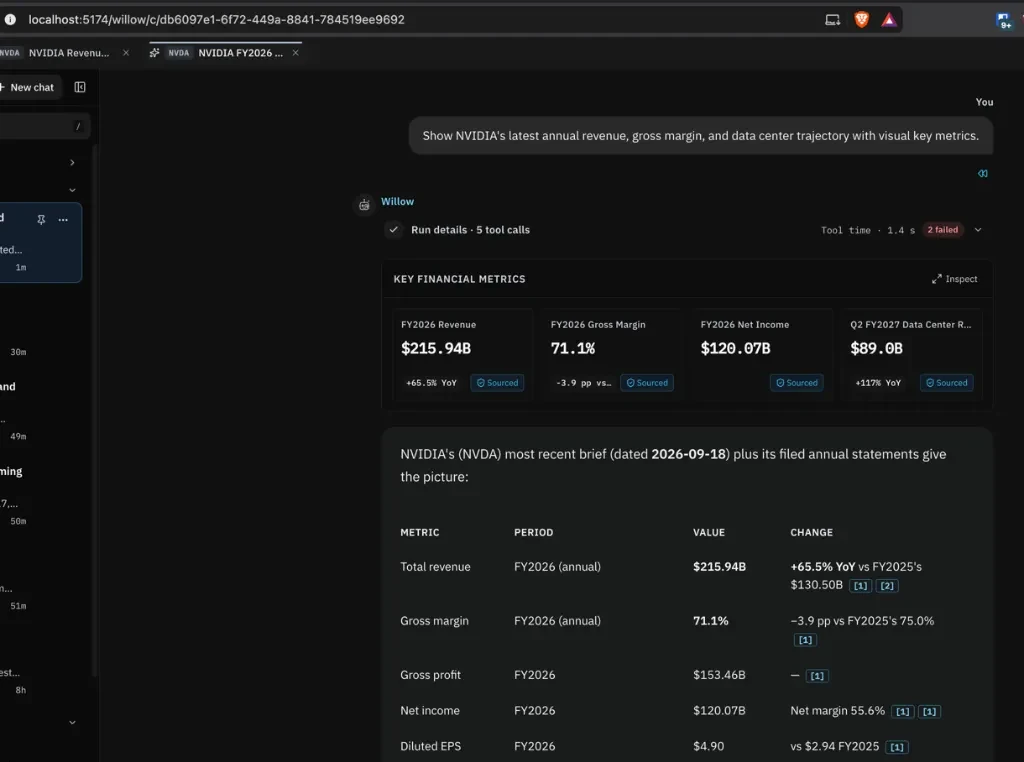
Willow completed the request in 1.4 seconds. Rather than writing a script to draw an image, it picked a key-metrics card built into the app, checked each value against the SEC filing it came from, and filled the card in.
The resulting KEY FINANCIAL METRICS component mounted instantly with interactive cards: FY2026 Revenue ($215.94B, +65.5%), FY2026 Gross Margin (71.1%, down 3.9 pp), FY2026 Net Income ($120.07B), and Q2 FY2027 Data Center Revenue ($89.0B, +117% YoY). Every metric carried a [Sourced] badge linking back to verified filing receipts.
Data Recency: Why ChatGPT Stopped at FY26 While Willow Captured Q2 FY27
A second major divide was data currency. ChatGPT answered exclusively from NVIDIA's fiscal 2026 annual report (period ended January 25, 2026). It correctly noted that annual Data Center revenue reached $193.7B, but its timeline ended eight months in the past.
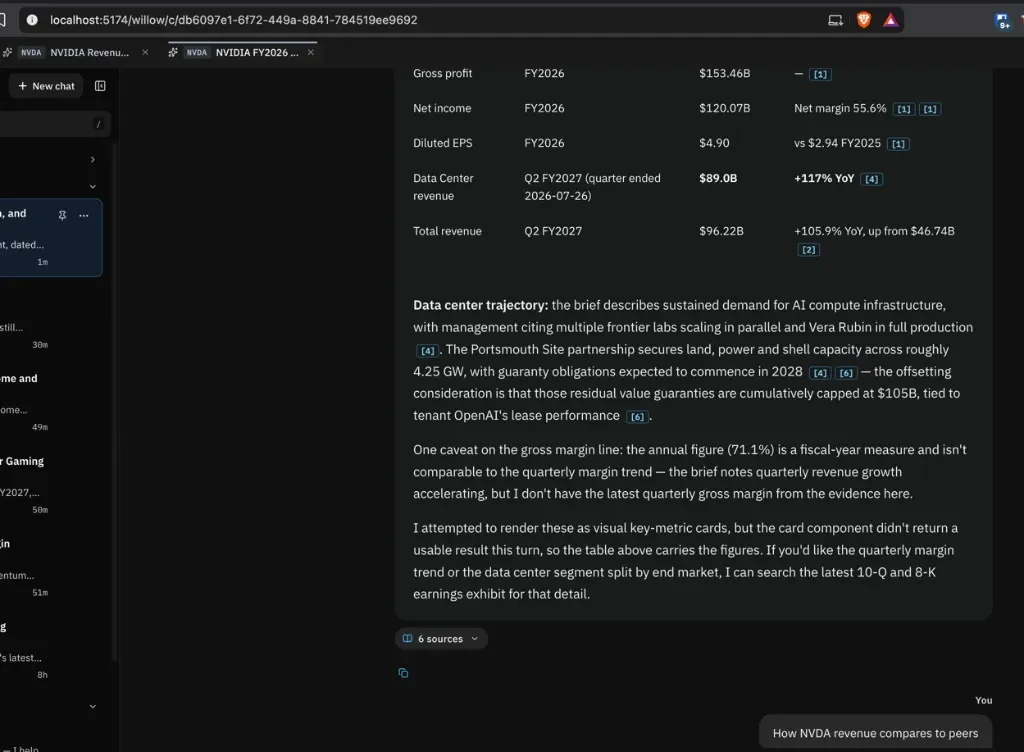
Willow anchored its search in NVIDIA's Form 10-K filed 2026-02-25, alongside its latest research brief dated 2026-09-18. As a result, Willow captured NVIDIA's subsequent Q2 FY2027 print (quarter ended July 26, 2026), where quarterly Data Center revenue reached $89.0B (+117% YoY) out of $96.22B in total quarterly revenue.
Willow also included a vital accounting caveat: it reminded the reader that the 71.1% gross margin is an annual fiscal measure and cautioned against conflating annual figures directly with quarterly margin trends.
AI That Reads 10-K Filings: Power Deals and the $105B OpenAI Guarantee Cap
General models typically regurgitate press releases and headline revenue. Specialized equity research software reads notes to consolidated financial statements and management disclosures.
In its qualitative trajectory analysis, Willow extracted two operational commitments from NVIDIA's recent filings that ChatGPT completely omitted:
1. Power and infrastructure commitments: NVIDIA secured approximately 4.25 GW of land, power, and shell capacity through its Portsmouth Site partnership, with guaranty obligations scheduled to commence in 2028.
2. Counterparty risk: NVIDIA's residual value guaranties under the facility are cumulatively capped at $105B, tied directly to tenant OpenAI's lease performance.
These second-order structural details determine whether compute capacity can physically be delivered. Surfacing these risks automatically is what distinguishes an equity research tool from a conversational chatbot.
The Builder's Reality: Intermediate Tool Retries and the 'Apology Glitch'
Building production agents reveals edge cases that do not show up in synthetic evals. The Willow run details display: 5 tool calls, Tool time 1.4s, 2 failed.
Directly above the narrative, the KEY FINANCIAL METRICS cards rendered as expected. Yet at the bottom of the message, Willow wrote:
'I attempted to render these as visual key-metric cards, but the card component didn't return a usable result this turn, so the table above carries the figures.'
Why did the agent apologize for cards that were visible on screen? Willow refuses to show a number it cannot match to a filing. The first two times it tried to fill the card, a change figure did not match the filing exactly, so the card was held back. On the third try every value matched and the card appeared.
However, the error messages from the two failed attempts remained in the model's intermediate conversation context. When generating its concluding prose, the model saw those error strings, concluded that the card component had failed, and generated an apology alongside a fallback markdown table. This highlights why production agent architectures must reconcile and scrub intermediate tool errors before the final synthesis step.
Related Research & Methodology
Frequently Asked Questions
Does ChatGPT hallucinate financial and stock data?
Yes. General-purpose models like ChatGPT generate tokens based on statistical probabilities rather than live database lookups. Without strict tool integration and deterministic receipt verification, they frequently confuse fiscal periods, miscalculate percentage growth, or state outdated numbers from their training cutoff.
What is the difference between ChatGPT and an AI stock research tool?
ChatGPT is a generalist assistant that either answers from memory or executes slow Python scripts in a sandbox. An AI stock research tool like Willow connects directly to SEC EDGAR filings, runs fail-closed numeric validation against primary receipts, emits native interactive UI components, and enforces balanced bull and bear arguments without giving directional investment advice.
Can AI equity research software read latest 10-K and 10-Q filings directly?
Yes. Willow indexes raw XBRL facts and full-text disclosures directly from SEC filings. When answering questions about revenue, margins, or segment trajectory, it cites the exact filing form, accession number, and period date.
Why does brief.finance refuse to provide price targets or buy/sell recommendations?
brief.finance is an educational research platform, not a broker or financial advisor. Predicting stock prices or issuing automated buy/sell signals creates legal liabilities and false certainty. Instead, the platform provides institutional-grade, two-sided research with verifiable evidence so researchers can draw their own conclusions.
Key Engineering Findings
- • Built-in cards beat static plots: Willow filled a checked metrics card in 1.4 seconds, compared to 23 seconds for ChatGPT to write and run a charting script.
- • Grounding requires deterministic receipt validation: Eliminating hallucinations requires rejecting any number that cannot be traced to an SEC filing.
- • Scrub intermediate error logs: Multi-turn agents need clean context hygiene so intermediate tool retries do not cause the model to apologize for successful UI emissions.
- • Multi-period queries need dedicated time-series components: Adding native sparklines or bar components alongside KPI cards fulfills trajectory prompts without latency penalties.